Insights from Health Geographies III: From Vertical Peaks to Horizontal Flows – Learning to Read Blue Spaces in Berlin (Summer term 2025)
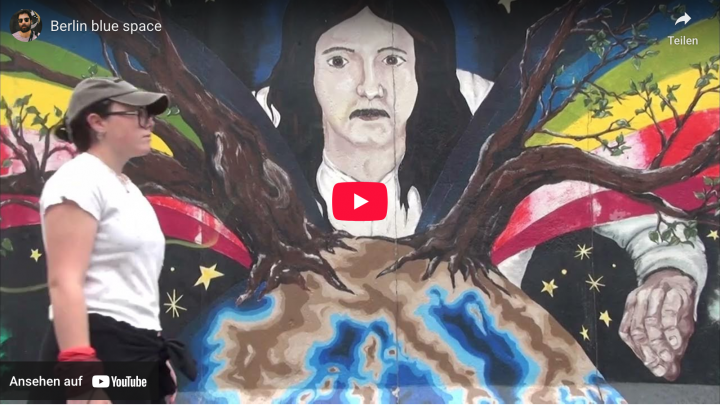
Text and Video by Pooria Poshtareh
I grew up in Tehran, a city where the Alborz mountains shape everyday life. When the city becomes overwhelming, you move upward. You hike, you climb, and you look for distance from noise and density. For me, restoration was always a vertical pursuit, a physical ascent toward clarity.
When I moved to Germany, first to Mainz and later to Berlin, this vertical reference disappeared. Berlin’s flatness felt disorienting; I did not know where to go when I needed space. It was through daily encounters with the Rhine in Mainz that I began to notice a different spatial logic. I watched how the river functioned as a steady, quiet anchor for people jogging, sitting on the steps, joining festivals or simply watching the water flow. Without fully naming it at the time, I was experiencing what Wilbert Gesler (1992) describes as a therapeutic landscape, a place where well-being emerges through sensory experience, social interaction, and symbolic meaning. Reading the research of Sebastian Völker and Thomas Kistemann (2011; 2013) helped me articulate this intuition. They describe urban blue spaces as visible surface waters that support everyday relief from stress. The river became a horizontal replacement for my mountains: an anchor that did not require ascent but invited movement alongside a fluid expanse.
I
N
T
R
O
D
U
C
T
I
O
N
Introduction: Mara Linden
In summer term 2025, students enrolled in the MA programme Human Geography: Globalisation, Media, and Culture (MA) participated in the seminar Current Debates on Globalisation, Media & Culture: Geographies of Health, led by me (Mara Linden).
Throughout the seminar, we worked with different geographical perspectives within the field of health geographies, focusing on inequalities and power imbalances around issues concerning health in local and global contexts. We covered topics such as (post)colonial global health, health and environment, One Health and more-than-human health, before our focus moved to bodies, reproductive health, clinical labour and organ markets. From there, we continued to discuss the economisation of health and the focus on security and preparedness in much of global health.
The following blog post is one of several in a series of what we call “insights” from health geographies. These blog posts are the students’ works: They creatively engaged with the themes and perspectives taken up in the seminar and used their own empirical data – from interviews and observations to visual material – to write essays, create websites or produce films or podcasts. Through these works, the students expanded the seminar discussions, reflecting and adding to what health geography means. By making these works available online, we hope to open further discussions on health geographies’ entanglements with everyday experiences, social inequalities, and urban life.
The Mobile Eye: Cycling the Fluid City
When I settled in Berlin, I wanted to explore these spaces beyond their idealized image. Influenced by our seminar’s focus on Critical Health Geography, I approached the city’s waterways as complex environments shaped by mobility. I chose to film most of my project from my bicycle. Cycling allowed me to move with the water; the rhythm of riding mirrored the unruly mobility of the river and made visible that exhale moment where dense streets open into air, light, and space.
Moving along the Spree and the Landwehrkanal, I began to read the city through three critical layers:
- Political & Economic Space: Along the Spreefront, access to the water is sharply divided. Community-oriented places like Holzmarkt, born out of resistance to commercialization, exist alongside the privatized developments of Mediaspree, where glass facades and fences regulate who may linger. This reflects process of described as “blue gentrification” by Dante Di Matteo et al. (2025) where proximity to water becomes a commodity for the wealthy rather than a shared resource.
- Memory & Historical Space: Berlin’s water carries scars. The Spree once marked a militarized border zone during the Cold War, and the Landwehrkanal holds the memory of political violence, such as the site where Rosa Luxemburg was found. As Till, K.E. (2012) argues, healing in these spaces is always partial because the landscape itself bears witness to division and loss.
- More-than-Human Space: The river is alive with ducks, swans, and invisible microbial life. Following Jamie Lorimer’s (2017) work, I began to see the city as a multispecies environment where human well-being is inseparable from ecological health. A polluted or stressed river undermines the very restorative promise it offers.
Conclusion: The Fragile Commons
This project became an ongoing exploration rather than a fixed conclusion. Moving from Tehran’s mountains to Berlin’s waterways forced me to rethink restoration not as a solitary ascent toward a peak, but as a negotiated, horizontal relationship with a fluid environment.
Berlin’s blue spaces are not simple solutions to urban stress; they are fragile commons. Their therapeutic quality is not guaranteed by the water itself but is produced through social justice, ecological care, and an acknowledgment of the histories they carry. Learning to read these spaces was my way of learning how to belong in a new city not by climbing above it, but by moving with its flows.
References
- Di Matteo, D., & Guadagno, E. (2025). Blue gentrification: Sustainably effective, socially regressive, or both? Impacts of coastal housing policies in Sardinia. Land Use Policy 157 (107666). https://doi.org/10.1016/j.landusepol.2025.107666.
- Gesler, W. M. (1992). Therapeutic landscapes: Medical issues in light of the new cultural geography. Social Science & Medicine, 34(7), 735–746. https://doi.org/10.1016/0277-9536(92)90360-3.
- Lorimer, J. (2017). Probiotic environmentalities: Rewilding with microbes and helminths. Geographical Journal, 34 (4), 27–48. https://doi.org/10.1177/0263276417695866.
- Till, K. E. (2012). Wounded cities: Memory-work and a place-based ethics of care. Political Geography, 31(1), 3–14. https://doi.org/10.1016/j.polgeo.2011.10.008.
- Völker, S., & Kistemann, T. (2011). The impact of blue space on human health and well-being – Salutogenetic health effects of inland surface waters: A review. International Journal of Hygiene and Environmental Health, 214 (6), 449–460. https://doi.org/10.1016/j.ijheh.2011.05.001.
- Völker, S., & Kistemann, T. (2013). “I’m always entirely happy when I’m here!” Urban blue enhancing human health and well-being in Cologne and Düsseldorf, Germany. Social Science & Medicine, 78, 113–124. https://doi.org/10.1016/j.socscimed.2012.09.047.