Eating in theory & eating in practice: Seminar Current Debates on Food and Eating (winter term 2025/26)
Text and photos by students in the MA Human Geography: Globalisation, Media, Culture
What happens when we take something as ordinary as eating seriously? Not just as a daily routine but as a way of thinking, relating and understanding the world? This question guided our seminar, Current Debates on Food and Eating, led by Dr Mara Linden over the past winter term 2025/26, as we explored food and eating as deeply social, political, geographical and ecological processes.
At the center of our discussions was Annemarie Mol’s Eating in Theory: A book that invited us to reconsider eating as an activity rich with philosophical meaning. Drawing on thinkers such as Hannah Arendt, Maurice Merleau-Ponty and Donna Haraway, Mol weaves together theory and everyday practice through empirical examples, making complex ideas accessible while challenging us to rethink how we engage with the world through food.
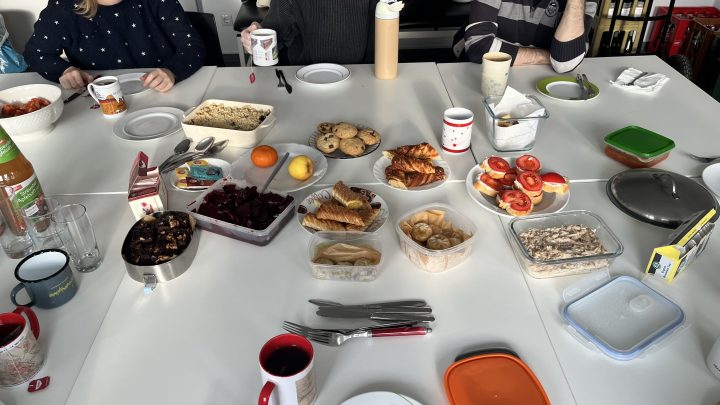
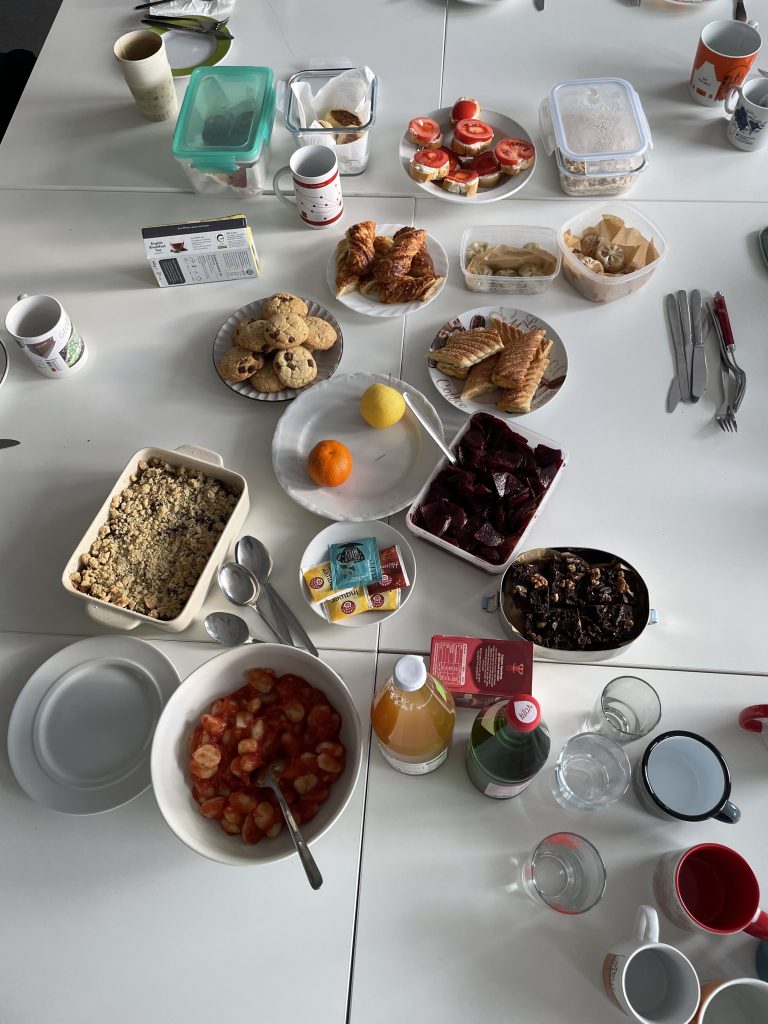
Throughout the seminar, we did not only read and discuss but we also experienced. In the spirit of the book, which emphasizes practice, we came together for a shared meal before our winter break. Each student brought a dish from their own cultural background and we ended up transforming the classroom and connecting beyond words. The act of eating together became a way of embodying the very questions we had been asking in class: How do we relate to others through food? And what can we learn about ourselves from eating? In the following, we reflect on our impressions of the book, the seminar discussions and the shared meal that brought theory to life.
“Can a bite of food imply more than meets the eye? Can there be a theory of eating? We explored these questions, debated them, and learned a lot from each other in the course titled “M5-MA Current Debates on Globalization, Media & Culture: ‘Food for thought’ – Theories on and with Eating.” The history of food, its relationship with the body and mind, and why we eat certain things and not others. Discovering cultural differences and building empathy… not only with each other, but with food, with animals, with a juicy red apple hanging on a branch. Do you know where digestion begins? You can explore all this from a whole new perspective in Annemarie Mol’s book “Eating in Theory.” We tried to do this together in class, bringing our cultural and social backgrounds with us, and I must say I had a lot of fun. I would like to thank our instructor Mara Linden and all my classmates for these enjoyable and educational discussions.”
– Deniz Can
“Eating often becomes an activity we do on autopilot, as if we only need it to recharge our bodies, to satisfy our biological needs. But it is so much more than that. It can be about sharing with family, building community, and constructing identities. In fact, it can be even more than that.
After weeks of meeting weekly as if we were a book club, I came to understand that, according to philosopher Anne-Marie Mol, eating involves actions we often consider distant, such as planting, harvesting, packaging, shopping, preparing food, and much more. It is a process that is not necessarily circular, but it resembles one, because it does not even end with those who chew the food; even our waste returns to the earth.
For me, reading the book Eating in Theory was not just a university requirement, it was a journey into myself, a personal reflection on my relationship with the world and with my eating practices. Since then, having lunch is no longer the same. I do not just see food; I see part of the process that allowed it to reach me. But this awareness is not always comfortable. Sometimes I wonder if it is even possible to fully acknowledge that entire journey, or if I am making good choices when I buy groceries, or when I fall back into eating on autopilot, ignoring what I have learned.”
– Laura Lucía González Contreras
“Our “Food for Thought” session explored food as more than nourishment as a medium of culture, memory, and social connection and our shared eating session brought this idea to life. Each of us brought a dish representing our country or personal heritage, creating a table full of stories and flavors.
I contributed kheer, a traditional Indian sweet made with rice, milk, sugar, and spices, often served during celebrations, which sparked curiosity and conversation. Other participants contributed a variety of dishes, each with its own unique texture, flavor, and story. From savory snacks to sweet treats, the table became a mosaic of cultures and experiences. Tasting each dish was more than a sensory activity it became a form of storytelling, where each bite connected us to distant lands, family traditions, and personal memories.
The diversity of flavors reminded us how food can bridge differences while sparking dialogue about culture, history, and identity. Tasting everyone’s dishes turned theory into practice, showing how food carries meaning, reflects identity, and builds social bonds. The session reminded us that eating together is not just about flavor but about sharing stories, traditions, and connection, making the ideas we discussed tangible, memorable, and delicious.”
– Anantha Lakshmi
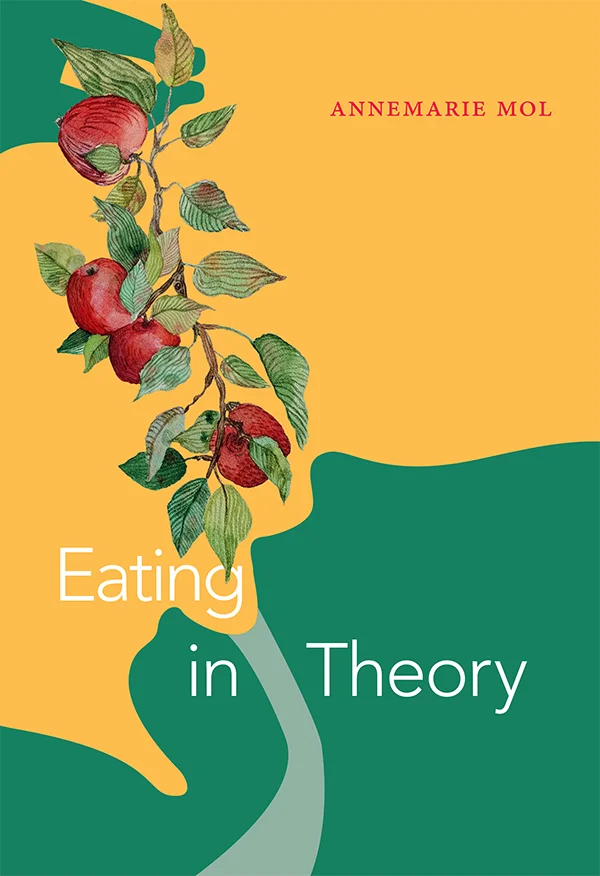
https://www.dukeupress.edu/eating-in-theory
Recipe: Baked Cauliflower
1 small cauliflower
1 cup yogurt
2 eggs
1/2 cup sunflower oil
1 tablespoon flour
Grated cheddar cheese
Salt, red pepper flakes
Instructions:
Cauliflower florets are separated and boiled in salted water.
In a deep bowl, mix all ingredients except the cheddar cheese.
Dip the boiled cauliflower florets in the prepared sauce and arrange them in a greased baking dish (you can pour any leftover sauce over them).
Bake in the oven at 200 degrees for about 20 minutes.
Then add the cheddar cheese and bake until the cheese melts and browns. Delicious form of vegetable.
Bon Appetit!
– Merve Çelik
Recipe: Plum Crumble
800g ripe plums (tastes also great with apples instead of plums)
2 packets of vanilla sugar
½ tsp ground cinnamon
100g cold butter/margarine
120g brown sugar
1 pinch of salt
220g wheat flour (type 405)
A little fat for the tin
Instructions:
1. Preheat the oven to 200 degrees (fan oven: 180 degrees) and grease a baking dish (approx. 18 x 25cm). Wash the plums, pat dry and cut in half. Remove the stones and cut the fruit into slices. Mix with vanilla sugar and cinnamon in a bowl.
2. Cut the butter into pieces, place in a bowl with the brown sugar and salt and knead roughly with your hands. Add the flour and work all the ingredients between your hands to form crumbs.
3. Place the plums in the prepared tin and cover generously with the crumble mixture, then bake the plum crumble in the preheated oven for approx. 25 minutes and serve warm. The plum crumble makes approx. 4 servings and will keep refrigerated for at least 2 days.
This also tastes great with vanilla ice cream!
– Maybrit Wilkens
Recipe: Joschiki (Little Hedgehogs)
600g Cottage cheese (Tworog)
2 Eggs
Sugar
Flour
Instructions:
1. Mix the cheese with the eggs and sugar (not too little).
2. Shape the mixture into a kind of thick pancake.
3. Put some flour onto a plate and turn your Joschiki in it.
4. Put them in the pan with some oil until they are golden from the outside.
5. Put them on a paper towel afterwards to remove excess oil.
– Dietrich Potschazki
Recipe: Brownies (vegan)
480g kidney beans (1 can)
100g oats
130g brown sugar (or different sweetener)
2 tbsp cocoa powder
100ml plant-based milk
50ml oil (canola, sunflower or similar)
100g apple sauce
100g dark chocolate
1 tsp baking powder
A pinch of salt
Optional: walnuts, almonds, more
chocolate, cherries, or other fillings
Instructions:
1. Preheat the oven to 180 C and grease a form (ca. 25x30cm).
2. In a mixer, grind the oats to a flour consistency and add to a bowl together with sugar, baking powder, salt and cocoa.
3. Rinse the kidney beans well and let drain in a colander. Roughly chop the chocolate and any optional additions and set aside.
4. Add plant milk, applesauce and oil to a mixer with the kidney beans and mix until it is homogenous. Combine bean mix and oat mix to a smooth dough, but without mixing too much.
5. Add 2/3 of the chopped chocolate and nuts to the dough and gently fold under. Add the dough to the prepared form and top with the remaining 1/3 chocolate and nuts. Bake the brownies for 20 minutes in the preheated oven, then let cool complete before removing from the form.
The brownies can be stored at least two days if kept airtight and cool. Enjoy!
– Mara Linden