RESEARCH/
Global health and foreign policy in Germany
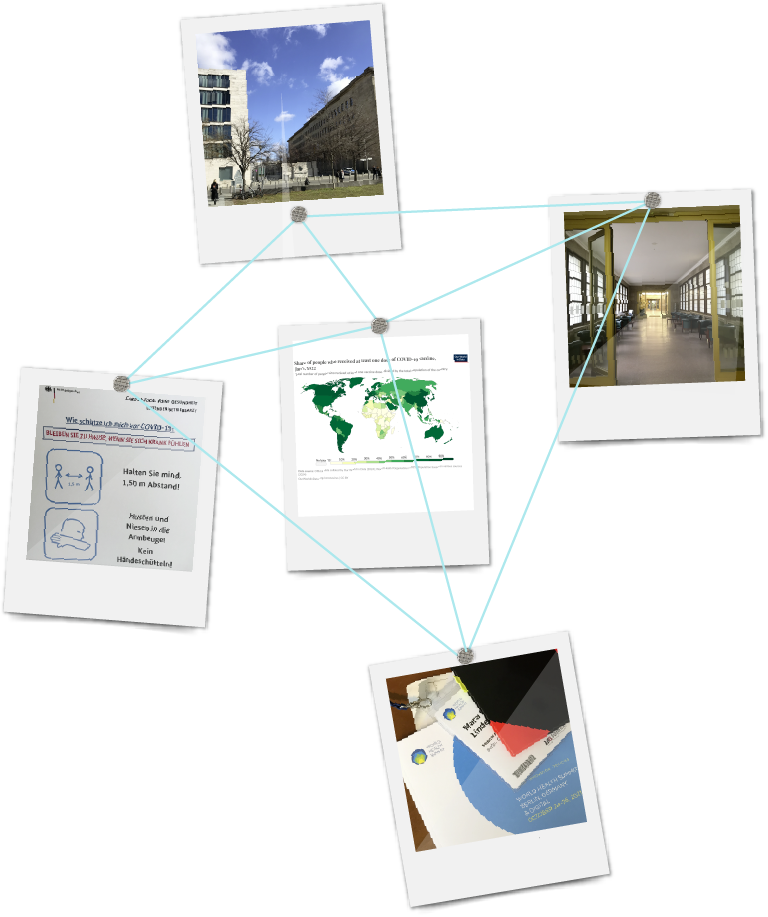
Based on ethnographic research in the German Ministry of Foreign Affairs, this PhD project examines the formation of a political field of global health and foreign policy in Germany and its consolidation and variation throughout the Covid-19 crisis.
The coordination of global health as a problem for foreign policy
The project highlights the particular coordinational role of the German Ministry of Foreign Affairs which, in 2015, formed a new position of a “Coordinator for the Foreign Policy Dimension of Global Health”. The creation of this position, so the argument, is embedded in recurring problematizations of global health in relation to security and economics over time and was reinforced by the publication of a German global health strategy and the Ebola outbreak 2014–15 as two exemplary moments contributing to the need of a coordinating position on global health. Consequently, this new position of a Coordinator consolidated an assemblage of global health and foreign policy in Germany, coordinating the ministerial and governmental efforts in the field of global health.
The Covid-19 pandemic initially disrupted these efforts; global health unexpectedly became a key topic for all governmental policies. Here, the project focuses on crisis governance, improvisation and adaption in the policy field of global health and foreign policy, analysing the changing role of coordination in the areas of aid deliveries, vaccine development, and in cooperation with international institutions and other relevant actors. The project uses insights from the governance of Covid-19 to illustrate a mode of ‘panic and neglect’ that characterizes crisis moments and makes them both exceptional (in terms of scope and scale) and non-exceptional (in light of preparedness and global health security narratives).
The coordination of Germany’s vaccine donations
Highlighting vaccines’ crucial role in global health and their entanglement with market logics, pharmaceutical production and economic interests, the project contextualises the vaccine donations during Covid-19 within the aforementioned field of global health and foreign policy between economic and security concerns. Vaccine donations coming from Germany were coordinated by the German Ministry of Foreign Affairs’ global health position, the Coordinator and the Covid-19 team. The project examines logistical-technical and socio-political challenges with the coordination in the context of wider inequalities in global health, infrastructural difficulties with transport and cooling, and power imbalances between pharmaceutical manufacturers, donating and receiving governments. From this case study of the vaccine donations, the project also posed questions about Germany’s role as a geo-economic player, in the sense of hosting pharmaceutical production at home and representing German economic interests elsewhere. Lastly, this project looks at the current state and future of global health, therefore also connecting to debates about global inequalities, fragmentation and contemporary multiple crises.
This PhD dissertation has been awarded the WISAG prize 2025 for the best dissertation in the humanities and social sciences at Goethe-University Frankfurt.
Project-related publications:
Linden, M. (2025) Global Health in Crisis? Security, Foreign Policy and Covid-19 in Germany. London: Routledge. https://doi.org/10.4324/9781003651017.
Bartl, G., Hardt, J. N., Suttner, S., Linden, M., Ventura, R. A., Vogler, A., … & Melcher, F. (2024) Rethinking Governance in Times of Multiple Crises, in: Vigoni Papers 2023, 5, 1–23.
Linden, M. (2020) Auswirkungen der Pandemie: Gesundheitskrise, Ökonomie und Ungleichheit, in: Geographica Helvetica 75, 3, 307–313. https://doi.org/10.5194/gh-75-307-2020.
Linden, M. (2020) Globale Gesundheitspolitik und Ökonomie. Ein Beitrag zur Reihe “Sicherheit in der Krise.” Soziopolis. https://nbn-resolving.org/urn:nbn:de:0168-ssoar-81968-1.
The coordination of global health as a problem for foreign policy
The project highlights the particular coordinational role of the German Ministry of Foreign Affairs which, in 2015, formed a new position of a “Coordinator for the Foreign Policy Dimension of Global Health”. The creation of this position, so the argument, is embedded in recurring problematizations of global health in relation to security and economics over time and was reinforced by the publication of a German global health strategy and the Ebola outbreak 2014–15 as two exemplary moments contributing to the need of a coordinating position on global health. Consequently, this new position of a Coordinator consolidated an assemblage of global health and foreign policy in Germany, coordinating the ministerial and governmental efforts in the field of global health.
The Covid-19 pandemic initially disrupted these efforts; global health unexpectedly became a key topic for all governmental policies. Here, the project focuses on crisis governance, improvisation and adaption in the policy field of global health and foreign policy, analysing the changing role of coordination in the areas of aid deliveries, vaccine development, and in cooperation with international institutions and other relevant actors. The project uses insights from the governance of Covid-19 to illustrate a mode of ‘panic and neglect’ that characterizes crisis moments and makes them both exceptional (in terms of scope and scale) and non-exceptional (in light of preparedness and global health security narratives).
The coordination of Germany’s vaccine donations
Highlighting vaccines’ crucial role in global health and their entanglement with market logics, pharmaceutical production and economic interests, the project contextualises the vaccine donations during Covid-19 within the aforementioned field of global health and foreign policy between economic and security concerns. Vaccine donations coming from Germany were coordinated by the German Ministry of Foreign Affairs’ global health position, the Coordinator and the Covid-19 team. The project examines logistical-technical and socio-political challenges with the coordination in the context of wider inequalities in global health, infrastructural difficulties with transport and cooling, and power imbalances between pharmaceutical manufacturers, donating and receiving governments. From this case study of the vaccine donations, the project also posed questions about Germany’s role as a geo-economic player, in the sense of hosting pharmaceutical production at home and representing German economic interests elsewhere. Lastly, this project looks at the current state and future of global health, therefore also connecting to debates about global inequalities, fragmentation and contemporary multiple crises.
This PhD dissertation has been awarded the WISAG prize 2025 for the best dissertation in the humanities and social sciences at Goethe-University Frankfurt.
Project-related publications:
Linden, M. (2025) Global Health in Crisis? Security, Foreign Policy and Covid-19 in Germany. London: Routledge. https://doi.org/10.4324/9781003651017.
Bartl, G., Hardt, J. N., Suttner, S., Linden, M., Ventura, R. A., Vogler, A., … & Melcher, F. (2024) Rethinking Governance in Times of Multiple Crises, in: Vigoni Papers 2023, 5, 1–23.
Linden, M. (2020) Auswirkungen der Pandemie: Gesundheitskrise, Ökonomie und Ungleichheit, in: Geographica Helvetica 75, 3, 307–313. https://doi.org/10.5194/gh-75-307-2020.
Linden, M. (2020) Globale Gesundheitspolitik und Ökonomie. Ein Beitrag zur Reihe “Sicherheit in der Krise.” Soziopolis. https://nbn-resolving.org/urn:nbn:de:0168-ssoar-81968-1.