RESEARCH/
Microbial-human relations of fermented dough
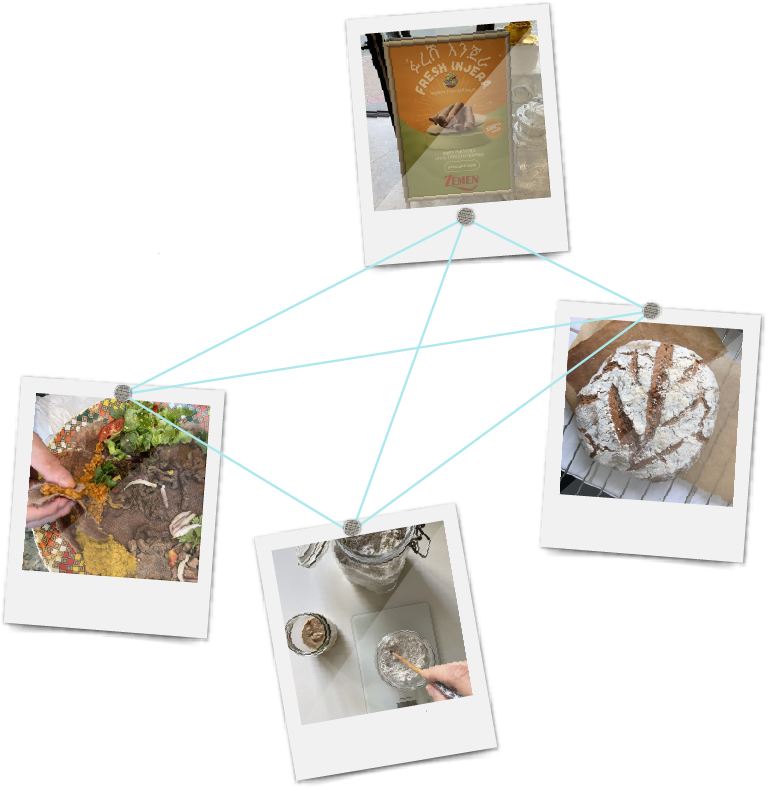
This project looks at sourdough and injera as cultural artefacts of human-microbial relations that are entangled with artisanal and cultural histories, significance of taste and migration, practices of experimentation, tacit knowledges, and contemporary food trends.
Fermented foods as “trends”
There is a ‘probiotic turn’ in “some parts of the WEIRD (Western, Educated, Industrialized, Rich, and Democratic) world”, Lorimer (2020, p. 1) postulates, places where the microbiome has gained particular attention in recent times. Accordingly, foods that are supposedly good for the microbiome have also become prominent, including fermented foods. Baking with sourdough, especially, has turned into a prominent hobby during the pandemic, as people stayed home, emphasising a quality of making sourdough bread at home and eating bread products with longer fermentation times to make it easier for the body to absorb minerals and vitamins. Here, the project asks how this trend relates to societal norms and expectations towards health, microbiome and microbes in our environment. It also analyses the reasons consumers and producers give for their preferences towards fermented dough products, and how they talk about sourdough bread and injera – as two bread products based on fermented sourdough – in relation to healthy foods and nutrition. Through these questions, the project examines the cultural significance that is attributed to sourdough bread and injera.
Knowledge, technologies, tradition, experiments
The trend of fermented foods is pointing to a possibly changing relation between humans and their surroundings, including microbial ones: from a pasteurised, antibiotic life to a probiotic, post-pasteurised life that acknowledges the role microbes play in contributing to healthy human lives. However, as these co-actors are, to a large degree, invisible to human eyes, these more-than-human relationships necessarily build on implicit knowledges and technologies that are shaped both by traditional practices as much as experimentation in context. Therefore, the project focuses on knowledges and technologies that might be interculturally and spatio-temporally similar (or different), asking how knowledge is shared and conserved, and what problems of translation over time and contexts might arise. It also analyses the role of experimentation, and how environment and surroundings require continuous experiments and adaptions. Hence, the project follows practices and technologies adapting traditional cultural knowledge for contemporary living arrangements.
Commodification and marketisation of fermented dough
Considering the fragility of microbial-based foods and ingredients and the experimentality of knowledge and techniques surrounding them, the project also looks at attempts of commodification, valorisation and marketisation for commercial use. It asks how sourdough products are valorised, how knowledge and techniques surrounding the practices are commodified and marketized, and which ways of commercial use are being developed (e.g., sourdough hotels). It also analyses which commodity chains are renewed or built from scratch, especially in traditional artisanal practices, and how these relate to global circulation. In this context, it is also relevant which local regulations might structure export and import, e.g. limitations for exporting Teff for making injera, or injera itself. Through these questions, the project examines if these developments are reduced to commodification and marketisation or if they also foster processes that encourage communal practices, sustainable living and healthy diets. In addition to academic contributions, this project incorporates dialogue with practice partners, among them artisanal sourdough bakeries and injera makers, participatory workshops and artistic representation.
Fermented foods as “trends”
There is a ‘probiotic turn’ in “some parts of the WEIRD (Western, Educated, Industrialized, Rich, and Democratic) world”, Lorimer (2020, p. 1) postulates, places where the microbiome has gained particular attention in recent times. Accordingly, foods that are supposedly good for the microbiome have also become prominent, including fermented foods. Baking with sourdough, especially, has turned into a prominent hobby during the pandemic, as people stayed home, emphasising a quality of making sourdough bread at home and eating bread products with longer fermentation times to make it easier for the body to absorb minerals and vitamins. Here, the project asks how this trend relates to societal norms and expectations towards health, microbiome and microbes in our environment. It also analyses the reasons consumers and producers give for their preferences towards fermented dough products, and how they talk about sourdough bread and injera – as two bread products based on fermented sourdough – in relation to healthy foods and nutrition. Through these questions, the project examines the cultural significance that is attributed to sourdough bread and injera.
Knowledge, technologies, tradition, experiments
The trend of fermented foods is pointing to a possibly changing relation between humans and their surroundings, including microbial ones: from a pasteurised, antibiotic life to a probiotic, post-pasteurised life that acknowledges the role microbes play in contributing to healthy human lives. However, as these co-actors are, to a large degree, invisible to human eyes, these more-than-human relationships necessarily build on implicit knowledges and technologies that are shaped both by traditional practices as much as experimentation in context. Therefore, the project focuses on knowledges and technologies that might be interculturally and spatio-temporally similar (or different), asking how knowledge is shared and conserved, and what problems of translation over time and contexts might arise. It also analyses the role of experimentation, and how environment and surroundings require continuous experiments and adaptions. Hence, the project follows practices and technologies adapting traditional cultural knowledge for contemporary living arrangements.
Commodification and marketisation of fermented dough
Considering the fragility of microbial-based foods and ingredients and the experimentality of knowledge and techniques surrounding them, the project also looks at attempts of commodification, valorisation and marketisation for commercial use. It asks how sourdough products are valorised, how knowledge and techniques surrounding the practices are commodified and marketized, and which ways of commercial use are being developed (e.g., sourdough hotels). It also analyses which commodity chains are renewed or built from scratch, especially in traditional artisanal practices, and how these relate to global circulation. In this context, it is also relevant which local regulations might structure export and import, e.g. limitations for exporting Teff for making injera, or injera itself. Through these questions, the project examines if these developments are reduced to commodification and marketisation or if they also foster processes that encourage communal practices, sustainable living and healthy diets. In addition to academic contributions, this project incorporates dialogue with practice partners, among them artisanal sourdough bakeries and injera makers, participatory workshops and artistic representation.